Medicinal uses of rhubarb
The Rhubarb Compendium
[Home]
[Recipes]
[Previous page]
[Next page]
11 - Medicinal Uses
Rhubarb has many uses. The most common is medicinal. Rhubarb has been used in medicines and folk healing for centuries.
11.1 - Medicine
Rhubarb and its Dietetic Action: It is recognized that rhubarb not only exercises a digestive action but it operates directly as a conveyer of bile salts. It can therefore be classed as a hepatic stimulant. Rhubarb performs its first digestive operation in the mouth by stimulating the taste buds with its pleasantly bitter flavor which gives a sense of cleansing out the oral cavity, preparing it to taste the coming food. When it reaches the stomach its digestive effects come into full play, causing an increase of the flow of gastric juice and inducing their movement, thus favoring the processing of the contents of the stomach. Besides stimulating the secretions from the liver which convey the bile salts, it assists the intestine in regulating the absorption of fats.22
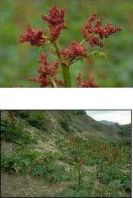
Rheum Palmatum (photo courtesy of Zucca)
Indications: Rhubarb is used as a laxative, antiphlogistic, and homeostatic in the treatment of constipation, diarrhea, jaundice, gastro-intestinal hemorrhage, menstrual disorders, conjunctivitis, traumatic injuries, superficial suppurative sores and ulcers. It is also applied externally for thermal burns. In TCM terms it Drains Heat and accumulations from the Yangming level, Clears Damp Heat, Cools the Blood, Invigorates Blood, eliminates Stagnant Blood and Clears Toxic Heat and purges knotted Heat and stool from the colon. Concepts in purgation In order to understand the use of purges in TCM it is important to understand the concepts and principles of purgation as applied in herbal practice. The 3 main types of purging are as follows: 1.Cold purge (heat clearing): for symptoms such as constipation due to inflammation and paralysis of the colon - i.e. knotted Heat. 2.Warm purge (inner warming): for acute circulatory disturbance of the digestive tract due to consumption of cold food and drink, and cold environment - i.e. cold accumulation or Yang deficient constipation. 3.Moistening purge (moisten dry intestine): for constipation due to dehydration or poor nutrition resulting in dryness of the intestine (insufficient colonic membrane secretions)
- i.e. dry intestine constipation. 4.Water expulsion: for hydrothorax, ascites, oedema.13
11.2 - This is new Stuff
Im still working on this part. This is a collection of notes.
HERBALFORMULAS FOR CLINIC AND HOME, The Southwest School of Botanical Medicine
2.2 LAXATIVE TEA
Psyllium Seed 3 parts
Licorice Root 3 parts
Rhubarb Root 2 parts
Senna
Pods (crushed) 2 parts
Angelica Root 2 parts
Drink as a simple infusion in evening.
2.4 COLON TONIC (Modified Thomsonian)
Cascara Sagrada 2 parts
Oregon Grape 2 parts
Cayenne 1 part
Ginger Root 1 part
Lobelia 1 part
Rhubarb Root 1 pt.
Stimulates peristalsis for chronic constipation of long duration. 2 “00” capswith water, morning and evening. When feces soften up go to 1 capsule twice a day
2.8 NEUTRALIZING CORDIAL (Modified)
Rhubarb Tincture 80 ml
Cinnamon Tincture 64 ml
Hydrastis Tincture 40 ml
Spirit of Peppermint 8 ml
Potassium carbonate 16 grams
Simple Syrup 250 ml
Diluted alcohol (50%) 550 ml
Step 1. Dissolve 16 grams of potassium carbonate in 250 ml Simple Syrup
Step 2.
Mix the tinctures, spirit and diluted alcohol.
Step 3. Mix both liquids, stirring or
blending until KCO3 is dissolved.
Step 4. Add additional diluted alcohol to the total
(if necessary) to bring the
total volume to 1000 ml.
Use a teaspoon or two for nausea, gas pains, dyspepsia, tenesmus, diarrhea ANDconstipation. An elegant pharmaceutical that may be the single closest thing to auniversal GI tonic. Unfortunately it is no longer made by any American manufacturer.
ELIXIRSAND FLAVORING EXTRACTS: Their History, Formulae, & Methods of Preparation, by John UriLloyd (1892)
ELIXIR OF RHUBARB
- ELIXIR OF RHUBARB.
Fluid extract of rhubarb, 2 fluidounces.
Simple elixir, 14 fluidounces.
Carbonate of magnesium, a sufficient quantity.
Triturate the fluid extract of rhubarb in a capacious mortar with carbonate of magnesium in amount sufficient to form a creamy mixture, then gradually add thesimple elixir, stirring well, and filter. Each fluidrachm of the finished elixirrepresents seven and one-half minims of fluid extract of rhubarb.
- COMPOUND ELIXIR OF RHUBARB.
Rhubarb, 20 troyounces.
Cloves, 8
troyounces.
Saffron, 8 troyounces.
Nutmeg, 20 troyounces.
Ether, 10 fluidounces.
Sherry wine, 200 fluidounces.
Diluted alcohol, 20 fluidounces.
Mix the drugs and reduce them to a coarse powder, and macerate this in the mixedalcohol and wine for fourteen days, stirring the mixture thoroughly each day; then filter,and add the ether. This elixir is recommended as a vehicle for disguising the taste ofcastor oil, and was introduced by Mr. Bidone Carlo, who states that one part of thiselixir will remove the taste and odor from three parts of castor oil. It was named”elixir of rhubarb,” but to avoid confusion with the regular and simple elixirof rhubarb we have added the word compound. (See New Remedies, 1880.)
- ELIXIR OF RHUBARB AND COLUMBO.
Elixir of rhubarb, 5 fluidounces.
Elixir of columbo, 5 fluidounces.
Simple elixir, 6 fluidounces.
Mix them together. Each fluidrachm of the finished elixir represents about two minimseach of fluid extract of rhubarb and fluid extract of columbo.
- ELIXIR OF RHUBARB AND MAGNESIA. (ELIXIR OF RHUBARB AND MAGNESIUM SULPHATE.)
Fluid extract of rhubarb, 4 fluidounces.
Sulphate of magnesium, 1024 grains.
Simple elixir, 32 fluidounces.
Carbonate of magnesium, a sufficient quantity.
Triturate the fluid extract of rhubarb with carbonate of magnesium until of a creamyconsistence, then gradually add the simple elixir, in which the sulphate of magnesium hasbeen previously dissolved; permit the mixture to remain for a few hours in a closedvessel, then filter. Each fluidrachm contains seven and one half minims of fluid extractof rhubarb and eight grains of sulphate of magnesium. Under the name elixir of rhubarb andmagnesia this elixir was noticed in New Remedies, 1877. Among the formulae introduced by Mr. G. W. Gardner to the American Pharmaceutical Association at its meeting in Saratogawas an “elixir of rhubarb and magnesium acetate.”
Wild Things (Quality OrganicHerbal Products) sells Rhubarb Root Tincture
Rheum palmatum
Part Used : Rhizome of Rheum palmatum and other species, not the garden rhubarb.
Constituents : Anthraquinone derivatives such as chrysophanic acid(=chrysophanol),emodin,
aloe-emodin, rhein &
physcion, with their O-glycosides such asglucorhein, chrysophanein,
glucoemodin;sennosides A-E, reidin C &others.
Tannins; in Chinese Rhubarb: d-catechin and epicatechin gallate, withvarious cinnamoyland coumaroyl golloyl glucosides and fructoses.
Stilbene derivatives; related stilbene glycosides present in othertypes
Miscellaneous; volatile oil, containing diisobutyl phthalate, cinnamicand ferulicacids; rutin, fatty acids, calcium oxalate etc.
Actions : Bitter, laxative, astringent.
Indications : Rhubarb Root has a purgative action for use in thetreatment ofconstipation, but also has an astringent effect followingthis. It therefore has a trulycleansing action upon the gut, removing debrisand then astringing with antisepticproperties as well. Note: Rhubarb Root maycolor the urine yellow or red. Priest &Priest tell us that it is a”mild stimulating tonic to alimentary mucous membrane,liver and gall ducts -removes viscid mucus. Small doses - tonic hepatic. Large doses -cathartic.”They give the following specific indications : diarrhoea anddysentary,summer diarrhoea, functional dyspepsia.
Ellingwood recommends it for the following patholgies : atonicconditions of the bowels,
with debility or
generalrelaxation, wether diarrhoea, dysentary, choleramorbus, cholera
infantum.
King’s Dispensatory gives it specific indications and uses as “gastricirritation, nausea, vomiting, elongated tongue reddened at tip and edges;irritative diarrhoea with tenderness on pressure; sour smelling dischargesimparting to a child a sour odour; gastro-intestinal irritation with nervousirritability, restlessness, screaming and convulsive muscular contractions;constipation, with a sense of intestinal constriction and abdominal contraction; light-coloured fecal discharge
Preparations & Dosage: Decoction: put l/2 - l teaspoonful of theroot in a cup ofwater, bring to the boil and simmer gently for l0 minutes.This should be drunk morning andevening. Tincture: take l-2ml of the tincturethree times a day.
[http://www.npicenter.com/library/herbal/materiamedica/RHUBARB.asp]
Readers of The Rhubarb Compendium may be interested in…
The Encyclopedia of Medicinal Plants
Andrew Chevallier
This practical reference is the first comprehensive, fully illustrated guide to medicinal plants and their therapeutic properties. Covering 550 key plants and their uses, Chevallier explains how medicinal plants work, how herbal medicine was developed, and how to use home remedies for a variety of common ailments. Organized alphabetically by Latin name. Full-color illustrations. [b13]
Footnotes
- 13.RHUBARB (Da Huang ) Rheum palmatum by Will Maclean and Peter Townsend, http://www.acupuncture.com/Herbology/Dahuang.htm, from Information on herbal medicine
- 22.Rhubarb, http://www.zucca.it/main/english/storia/cap_il_rabarbaro_e_la.html, From Zucca
[Home]
[Recipes]
[Previous page]
[Next page]
[About]
[Contribute]
© RhubarbInfo, 1996-2003
Updated on September 1, 2004
Email: dan at rhubarb info dot com