Rhubarb Varieties
Rhubarb, Rheum x coltorum is available in many cultivars (named hybrid varieties). One important characteristic of the different cultivars is the stalk color which can range from red to green. In between colors are often called pink or speckled.
A deep red petiole is the more popular among consumers, but these plants are often accompanied by poor growth and yield. Green varieties are often much more productive. Consumers also often assume the red stemmed rhubarb is sweeter than other colors but color and sweetness are not necessarily related. The Victoria variety, which is probably the greenest variety, can produce some very sweet stems.
An web search turned up 100’s of web pages mentioning various assorted varieties of rhubarb and some description on its growth, color, popularity and flavor. Below is a summary. Some of the information is contradictory, some is just vague. Some of the varieties are mentioned but no description is provided. Some of the differences can be accounted for by considering differences in personal opinion (like if its not red stems is it Pink or Green). Also, different names may be assigned to the same variety in different regions or countries as people move planting material from one location to another. The most common difference I found is the color of Victoria which be be accounted for when considering that this is probably the most common rhubarb variety grown from seed. When a hybrid plants seeds are planted, its offspring will not necessarily be true to the parent, you will get a mix of plants ranging from green through pink with a few plants with red or partly red stems.
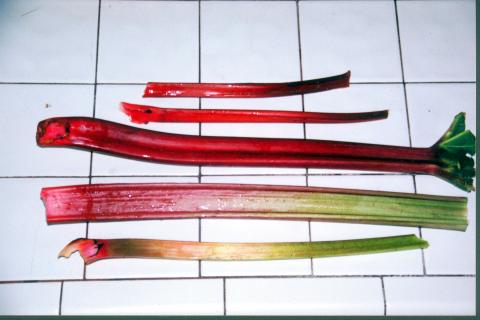
Assorted Rhubarb
 photo credit
- Canada Red - Smallish red stalks throughout, long thick petioles, Introduced in Canada and very popular, Stems are shorter and more slender than many seedling types but very tender. High quality and good red color, produces few seed stalks.
- Chipman - Also known as Chipman’s Canada Red, red stalks.
- Cherry Red - Also known as Cherry, Early Cherry - Vigorous, red which is reportedly grown in California, producing long, thick, deep-red stalks. stalks.
- Crimson Red - Also known as Crimson Cherry, Crimson Wine, Crimson. This is reportedly the only variety of consequence in Oregon. It produces brightly colored red stalks with the unique characteristic of being red throughout under normal temperature and moisture conditions of the Pacific Northwest.
- Egyptian Queen - Fine flavor, medium size.v
- Fraulein Sharfer Torte - Produces very fat, red, tart leaf stems for use in cooking. This is a select German cultivar with superior culinary attributes.
- German Wine - green petioles, similar to Victoria but slightly more vigorous and more intense in color, typically with a darker Pink speckling on a green stem.
- Glaskin’s Perpetual - Bright red, can be pulled 1st year after sowing.
- Hawke’s Champagne - Reliable early variety.
- Holstein Bloodred - Vigorous grower, crops juicy dark Bloodred sticks.
- Linnaeus - The standard for earliness, thin tender skin. Comparatively small stalks.
- Macdonald - Also known as Macdonald’s Canadian Red, Macdonald Crimson - , Large stalks, deep, Vigorous and upright-growing, Resistant to wilt and root rot, Probably the most common variety available, bright red, Highly productive, extremely vigorous and wilt resistant, Very good red color, excellent for pies, canning and freezing, pink petioles and medium to heavy seed stalk production, another pink type which produces well.
- Mammoth Red - Also known as The Giant, Stott’s Mammoth or simply Mammoth. Tremendous crop, plant grows 4-5 feet (1.25-1.5 m) high. Stalks are deep red.
- Mammoth Green - I have no information on this variety.
- Monarch - A Scotch import from around 1907. Large stalks with rough skin. Resembles Mammoth Red.
- Paragon - I have no information on this variety.
- Prince Albert - Early variety, provides good crop of long stalks.
- Redstick - Excellent flavor.
- Riverside Giant - Cold-hardy, vigorous producer with large diameter long green stalks.
- Ruby - I have no information on this variety.
- St. Martin’s - A variety of English origin. Ready about 1 week later than Linnaeus.
- Strawberry - pink petioles, red petioles, medium to heavy seed stalk production, Large sticks with both interior and exterior rose color, very similar to Victoria and may be the same variety, pink stalks.
- Sunrise - A pink variety. Sunrise rhubarb was a selection from open-pollinated seed of the Ruby variety of Rhubarb. Sunrise has a thicker stalk than Ruby, is more productive, has a higher quality and is more suitable for forcing. Sunrise was selected in the 1940’s and is still grown today in Nova Scotia.
- Sutton - Also known as Sutton’s Seedless, Large stalks, pink petioles.
- Tilden - Also known as Tilden’s Canada Red. A strain that has been selected for many years by the Tilden family. Not as upright as the Macdonald strain.
- Tottle’s Improved - I have no information on this variety.
- Timperely Early - Superb flavor, a very early variety good for forcing.
- Valentine - Thick red stalks, Excellent for home gardeners, long red stalks, Deep red petioles that retain their color when cooked, Vigorous, Known for its red petioles and the production of few or no seed stalks.
- Victoria - Also known as Large Victoria, Easily raised from seed, pull after one years growth, juicy, medium sized stalks, green, a popular forcing type, greenish leaf stalks, a heavy producer, excellent for commercial purposes, red and green stalks, One of the newer more intensely colored rhubarbs, It has large, thick, red stalks with good productivity, sweet and not tough or stringy, green petioles, heavy seed stalk production, Late forcing variety, producing large sticks of good flavor, produces large stalks of excellent quality, long, round with smooth ribs. It develops pink speckling on a light green stalk with the pink color being more intense at the bottom of the stalk, fading to a solid green near the top.
References:
(yes, I know many of these links are old an broken. I have not had the time to chase down new locations):
- Untitled web page, http://agweb.clemson.edu/Hort/drd/Rhubarb.html
- Rhubarb, http://pine.usask.ca/cofa/departments/hort/hortinfo/veg/rhubarb.html, from College of Agriculture, University of Saskatchewan
- 03900106 (Growing Rhubarb),http://lep.cl.msu.edu/msueimp/htdoc/mod03/03900106.html, Rhubarb: Cultural Guidelines for Michigan, Diana Helsel, Dale Marshall and Bernard Zandstra Cooperative Extension Service, Michigan State University
- RHUBARB - Rheum rhaponticum, http://uaexsun.uaex.arknet.edu/Vegfacs/rhubarb.html, from The Arkansas Cooperative Extension Service
- 1995 SELECTED LIST OF VEGETABLE VARIETIES FOR HOME GARDEN USE IN NEW YORK STATE, http://gopher.cce.cornell.edu/CGI/scripts/library.cgi/vegvariety-lib/file/homegard.95
- SEEDS-BY-SIZE VEGETABLE SEED LIST, http://www.seeds-by-size.co.uk/mainveg.htm, from SEEDS-BY-SIZE, HERTFORDSHIRE UNITED KINGDOM
- Rhubarb, http://pine.usask.ca/cofa/departments/hort/hortinfo/veg/rhubarb.html, from College of Agriculture, University of Saskatchewan
- Selected Vegetable Cultivars for Nebraska, Susan Schoneweis, Extension Coordinator Home/Environmental Horticulture, http://ianrwww.unl.edu/ianr/pubs/nebfacts/nf92-69.htm, University of Nebraska-Lincoln, Institute of Agriculture & Natural Resources
- Edible Ornamentals, http://www.sln.potsdam.ny.us/eorn.html
- Rhubarb in the Home Garden, http://www.ohioonline.net/garden.html, OhioOnline: Gardening Page
- Untitled web page, http://www.spokane.edu/garden/c119.htm, WSU Cooperative Extension in Spokane County
- Asparagus and Rhubarb, December 1987, Reviewed and reprinted April 1995, Ronald C. Smith, Extension Horticulturist and Turfgrass Specialist, http://ndsuext.nodak.edu/extpubs/plantsci/hortcrop/h61w.htm, North Dakota State University Extension Service
- Commercial Vegetable Production Guides, http://www.orst.edu:80/Dept/NWREC/rhubarb.htm, Oregon State University, College of Agricultural Sciences
- The New Rhubarb Culture, J. E. Morse, 1922, A complete guide dark forcing and field culture, how to prepare and use rhubarb.
- Rhubarb: The Wondrous Drug, Clifford M. Foust, 1992
- Horizon Herbs Catalog, http://www.horizonherbs.com/
- Last updated: Mon, 06/14/2010 - 20:28